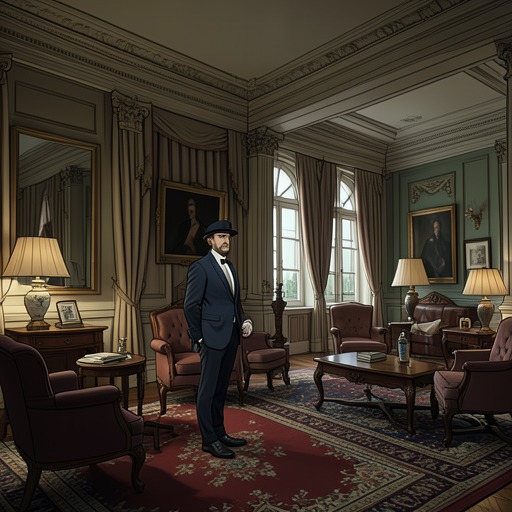
Rooms within rooms, doors beyond doors
A Gentleman in MoscowRooms within rooms, doors beyond doors is the principle by which the Metropol becomes more than the visible rooms its guests occupy: it is a concealed system of work, passage, memory, and possibility. Through Nina’s guided explorations and Count Alexander Ilyich Rostov’s later discovery of a space behind his closet, the idea changes from a description of the hotel’s architecture into a way of understanding how confinement can contain unexpected room for freedom.
The Hotel as a Hidden System
At first, Count Alexander Ilyich Rostov’s knowledge of the hotel is the knowledge of a guest: he can ask for mail and visit the hotel’s public-facing places, but those visits do not reveal the spaces that make the establishment function. The Metropol, Nina shows him, has an unseen geography behind its familiar face. Its linen closets, laundries, pantries, switchboard, and service passages are not incidental gaps in the building but the infrastructure that sustains its visible social life.
The comparison to a steamship gives this contrast its scale. A passenger may dine at the captain’s table, play baccarat, and enjoy an evening on deck while still seeing only a fraction of the vessel. The liveliness and elegance above depend on the crowded, largely unseen levels below. In the same way, a hotel guest can mistake a polished public world for the whole building. The image makes hidden space not merely mysterious but socially necessary: what is out of sight is also what keeps the visible world moving.
Nina’s own experience demonstrates how radically the building’s scale depends on what a person learns to notice. She has explored below, behind, and around its public rooms. As her knowledge expands, so does the imaginative reach of the hotel: first it seems to encompass two city blocks, then half of Moscow, and, if she remains there long enough, potentially all of Russia. This is not a literal enlargement of the structure. It is a change in the map made by experience, in which every newly discovered connection makes the known world feel larger.
Nina’s Course of Study
Nina begins Count Alexander Ilyich Rostov’s education at the bottom of the building. Through a heavy steel door, she leads him into the boiler room, where steam escapes from valves and a small furnace burns day and night. Its fire has an unexpected second use: it can destroy secret messages and illicit love letters. Their exchange about whether he receives such letters adds a teasing intimacy to what is otherwise a lesson in the hotel’s workings. A hidden room, the scene suggests, may offer not only passage or shelter but a means of keeping secrets—or disposing of them.
The electrical room supplies a different kind of hidden power. Nina shows him the lever that can plunge the ballroom into darkness, creating cover for someone to snatch pearls. Here the unseen system beneath the hotel connects directly to what happens in its most public spaces: a mechanism in a back room can abruptly change the conditions in an elegant ballroom. The hotel’s architecture contains both everyday service and the possibility of disruption.
Another turn through the basement brings them to a cluttered room for objects guests have left behind: umbrellas, Baedekers, and heavy novels abandoned when their owners no longer want to carry them. Among them are a pair of oriental rugs, a standing lamp, and the satinwood bookcase Count Alexander Ilyich Rostov had left in his former suite. The room makes the building’s hidden geography a repository of past lives. What has been discarded from the visible rooms has not vanished; it has been gathered in another room, waiting out of sight.
The exploration also leads to a locked store of the hotel’s silver service, piled on shelves from floor to ceiling. Nina wears the key on a delicate chain around her neck. Once she removes it and passes it to Count Alexander Ilyich Rostov, he turns it in a skull-shaped keyhole and opens the door to reveal the shining silver. Nina asks what it is for; he answers that it is for banquets. The sequence brings together secrecy, access, and display: the service that will gleam in public is kept behind a locked door, and access to the hidden store depends on a key concealed in plain sight.
From Basement Passages to Private Vantage Points
Nina’s lessons do not remain below ground. After they have explored the basement, the mail room, the switchboard, and other corners of the first floor, she takes Count Alexander Ilyich Rostov upstairs into the suites. Their interest in private rooms is not presented as a search for valuables or an intrusion for its own sake. It is an inquiry into how differently the hotel can be seen from one window to another.
The view depends on a room’s height and orientation, but also on season and time of day. From room 322, one can watch battalions march toward Red Square on the Seventh of November. The deep window ledges of room 405 make it possible to drop snowballs on unsuspecting passersby. Even the dismal room 244, looking onto an alley, has its own small spectacle: fruit sellers gather at the kitchen door, where an apple may occasionally be tossed down to them. Rooms therefore function as distinct points of access to the city, each framing a different kind of public life. The same building that hides its own workings also offers its occupants multiple ways of seeing beyond itself.
That abundance of viewpoints sharpens the contrast between Nina’s expansive knowledge and Count Alexander Ilyich Rostov’s restrictions. Looking into Suite 317, he recognizes the unremarkable sequence of a gentleman’s afternoon: a return at four, a jacket hung on a chair, tea and an afternoon edition, an hour on the couch before dressing for dinner. What he sees is not simply comfortable furniture but a daily interval available to someone at liberty. By comparison, his assigned room of one hundred square feet seems painfully cramped. Its bed, coffee table, chair, and closet crowd one another, leaving no space for the civilized hour he has just imagined.
The Room Behind the Room
The phrase returns to Count Alexander Ilyich Rostov as he stands before that cramped closet. He suspects that its elaborate molding may conceal an old doorway. When he parts his clothes and presses the closet’s back wall, it flexes. He removes his jackets, kicks through the thin barrier, and passes into a dark, narrow space smelling of dry cedar: the neighboring closet. From there, he opens a door into a room the same size as his own, where five unused bedframes have been stored. Two fallen frames block the hall door. He moves them, clears the room, and begins to furnish the space.
This discovery turns the hotel’s hidden geography into a practical answer to confinement. Count Alexander Ilyich Rostov hammers nails through the connecting door and its frame until his new room can be entered only through the sleeves of his jackets. He saves another nail to hang his sister’s portrait above the bookcase. The secret room is not simply additional floor area: its concealed entrance makes it a space over which he can exercise a measure of control, while the portrait and books give it a personal character absent from a room assigned for practical use.
The two rooms have identical dimensions but exert different influences on him. The bedroom, with its bed, bureau, and desk, belongs to necessity and other people’s authority. The study contains books, the Ambassador, and his sister’s portrait; it serves what is essential to the spirit. Its secrecy changes how its size feels. A room governed by others seems smaller than its measurements, while one concealed from their authority can seem vast. The contrast gives the recurring idea its decisive significance: hidden space does not abolish confinement, but it allows Count Alexander Ilyich Rostov to make something private and inwardly expansive within its limits.
In the study, he retrieves a volume from the ten books he had found in the basement and reads a familiar opening about happy and unhappy families. He has read the story before, yet the act is not reduced to nostalgia or idleness. His foot rests on the coffee table as he balances his chair on its hind legs and settles into the room. What began as a literal search for space has become the recovery of a chosen habit: the concealed room lets him read, remember, and inhabit time on terms that are his own. Across the hotel’s boiler room, locked silver store, forgotten-object room, varied windows, and hidden study, rooms within rooms means that the apparent boundary of a place is not always its final one.